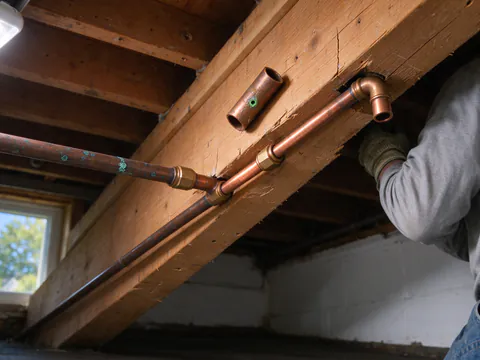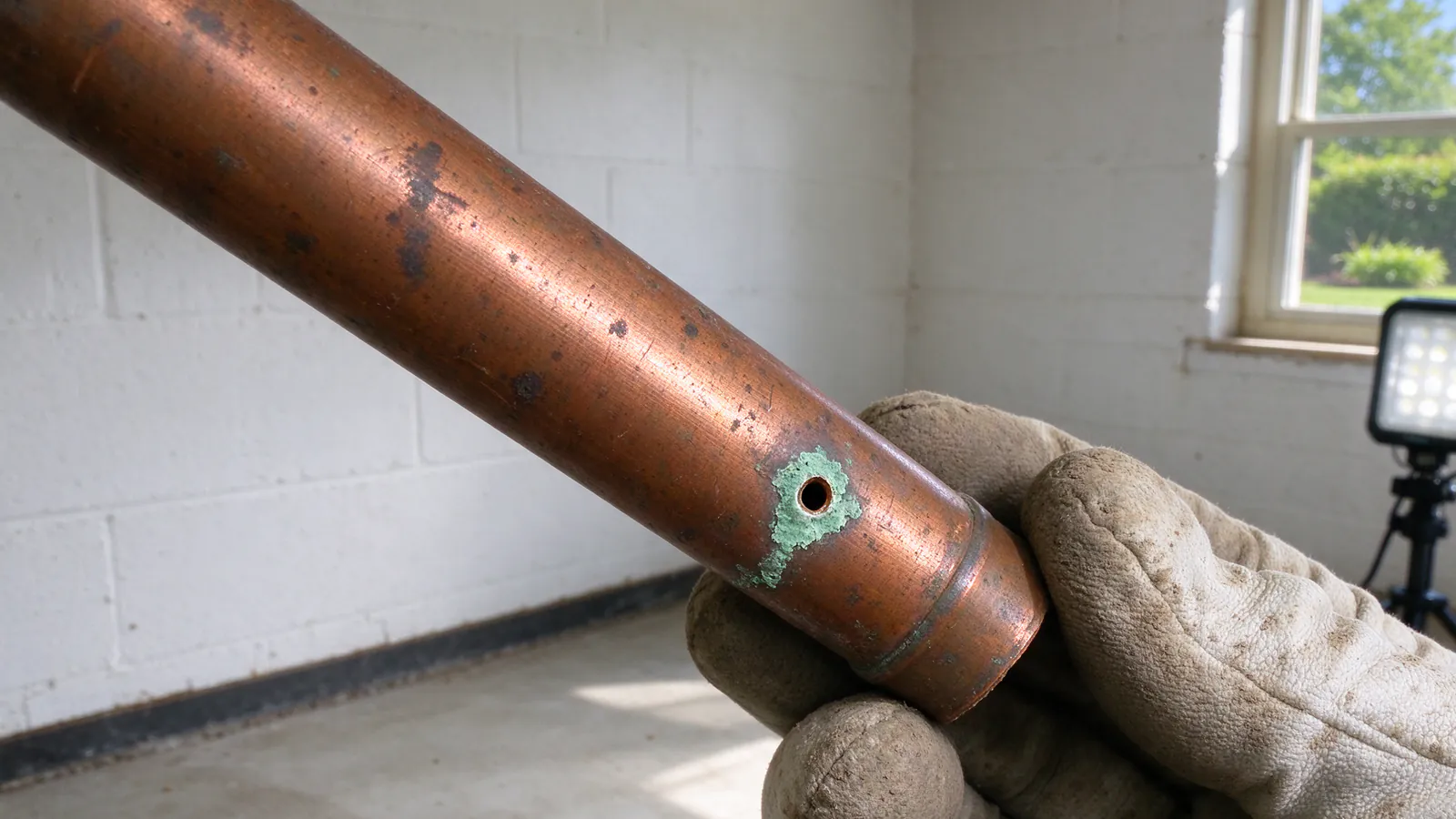
Copper pinhole leaks come from the pipe wall thinning in one spot until water breaks through. The usual causes are pitting corrosion tied to water chemistry, erosion from high water velocity, flux or debris left inside the pipe, and stray electrical current. No single cause explains every house, and one pinhole does not prove the system is failing.
Slate Repiping Columbus offers and manages copper pipe repair and copper repiping in Columbus and nearby Franklin County communities, carried out by licensed and insured plumbing contractors. This guide covers why copper thins, what Columbus water treatment means for it, and how to read a pattern of leaks.
Why the wall thins
Copper does not rust like steel, but it does corrode. Most of the time it forms a thin, stable film on the inside that slows further corrosion. A pinhole happens where that film fails in one small spot and the metal under it is eaten away faster than the rest. The list of possible reasons is long, and more than one can act at once.
Pitting corrosion
Pitting is localized attack. It can start under a deposit, at a flaw in the protective film, or where the water’s chemistry favors it, and it digs a narrow pit through the wall while the pipe around it looks fine. Pitting in cold-water lines and pitting in hot-water lines can follow different chemistry, which is one reason two houses on the same street can behave differently.
Erosion from water velocity
Water moving too quickly wears the protective film away, especially where flow turns: just past an elbow, a tee or a fitting whose cut end was left with a burr. Undersized lines, oversized pumps and hot water recirculation loops that run constantly raise the risk. Erosion damage tends to cluster just downstream of fittings.
Workmanship
Flux left inside a joint keeps working on the copper after the job is done. Burrs from cutting, debris left in the line, and overheated joints all create weak spots. These leaks often show near joints rather than in the middle of a straight run.
Electrical current
Where metal water pipe is part of the electrical bonding path, current on the pipe can contribute to corrosion in some conditions. Homeowners sometimes ask whether replacing part of the plumbing with PEX changes grounding and causes leaks in the remaining copper. It is a fair question for an electrician, not something to assume either way.
Thin wall and age
Type M copper has a thinner wall than Type L, so the same rate of attack breaks through sooner. Copper that has been in service for decades has simply had longer to thin.
Columbus water and copper
Columbus treats its water in ways that are meant to protect pipe. The City lime-softens it, then adds carbon dioxide to bring the pH down to about 7.8, and adds a zinc orthophosphate corrosion inhibitor at the end of treatment, according to its water quality report. Hardness at the three plants runs about 5.7 to 7.3 grains per gallon.
The plants are not identical. Dublin Road and Parsons Avenue water carry more chloride than Hap Cremean water, and alkalinity differs between them. Which plant feeds a house depends on where it is. None of those figures, on its own, explains why a particular pipe has pinholes; they are context for the questions a plumber asks.
Homeowners report pinhole leaks in central Ohio as well. A homeowner in the Powell area describes more pinholes appearing on horizontal copper runs in 1990s and newer homes on municipal water, and says different tradespeople offered different explanations. That is a homeowner report, not a rate or a finding, but it matches what the trade knows: the cause has to be found house by house.
Second pinhole in the same run?
A walk-through looks at where the leaks are, the pipe type and the velocity before anyone recommends repair or replacement.
Reading the pattern
The pattern says more than any single leak. These are the questions that separate a one-off from a run that is going:
| What you see | What it suggests |
|---|---|
| One pinhole in years, nothing nearby | A local flaw; a section repair usually fits |
| Two or more pinholes in the same run | The run is thinning along its length |
| Leaks clustered just past elbows or tees | Velocity or erosion; sizing and flow need a look |
| Leaks near joints | Flux, overheating or joint workmanship |
| Leaks on the bottom of horizontal runs | Pitting under deposits; compare with other horizontal runs |
| Green or blue-green crust along a run | Weeping spots that have not dripped yet |
| Leaks on both hot and cold, in different parts of the house | A system-wide condition rather than one bad section |
The most useful evidence is the pipe itself. When a leaking section is cut out for repair, keep it. Splitting it open shows whether the inside is pitted along its length or sound apart from one spot, and how thin the wall is near the hole.
Repair options
A clamp or a putty patch stops a drip for now. It is not a repair. A lasting fix cuts out the damaged section and joins in new copper with soldered or press fittings, or transitions to PEX with listed fittings.
Epoxy lining is sold as a way to coat the inside of leaking copper without opening walls. It has its own limits and questions, covered in the pipe lining vs repiping guide.
When a pattern means replace
Repair keeps making sense while leaks are rare and isolated. A pattern changes that:
- a second or third leak in the same run,
- leaks in several runs on both hot and cold,
- a cut-out section that shows pitting along its length,
- leaks inside finished walls or ceilings, where each repair also means opening and patching, or
- leaks under a slab, covered on the slab leak repair page.
Replacing just the affected run is a partial repipe. Replacing everything is a whole-house repipe, and the PEX vs copper guide covers what goes back in. The repipe vs repair guide sets out where the line usually falls, and the insurance guide explains how water damage and wear are usually treated differently.