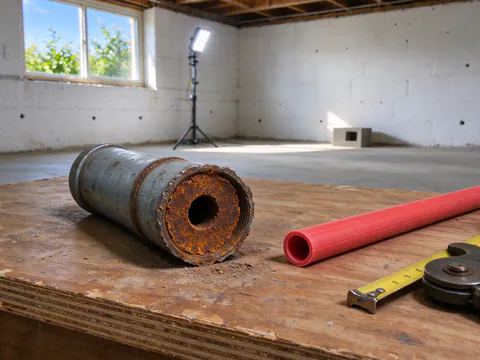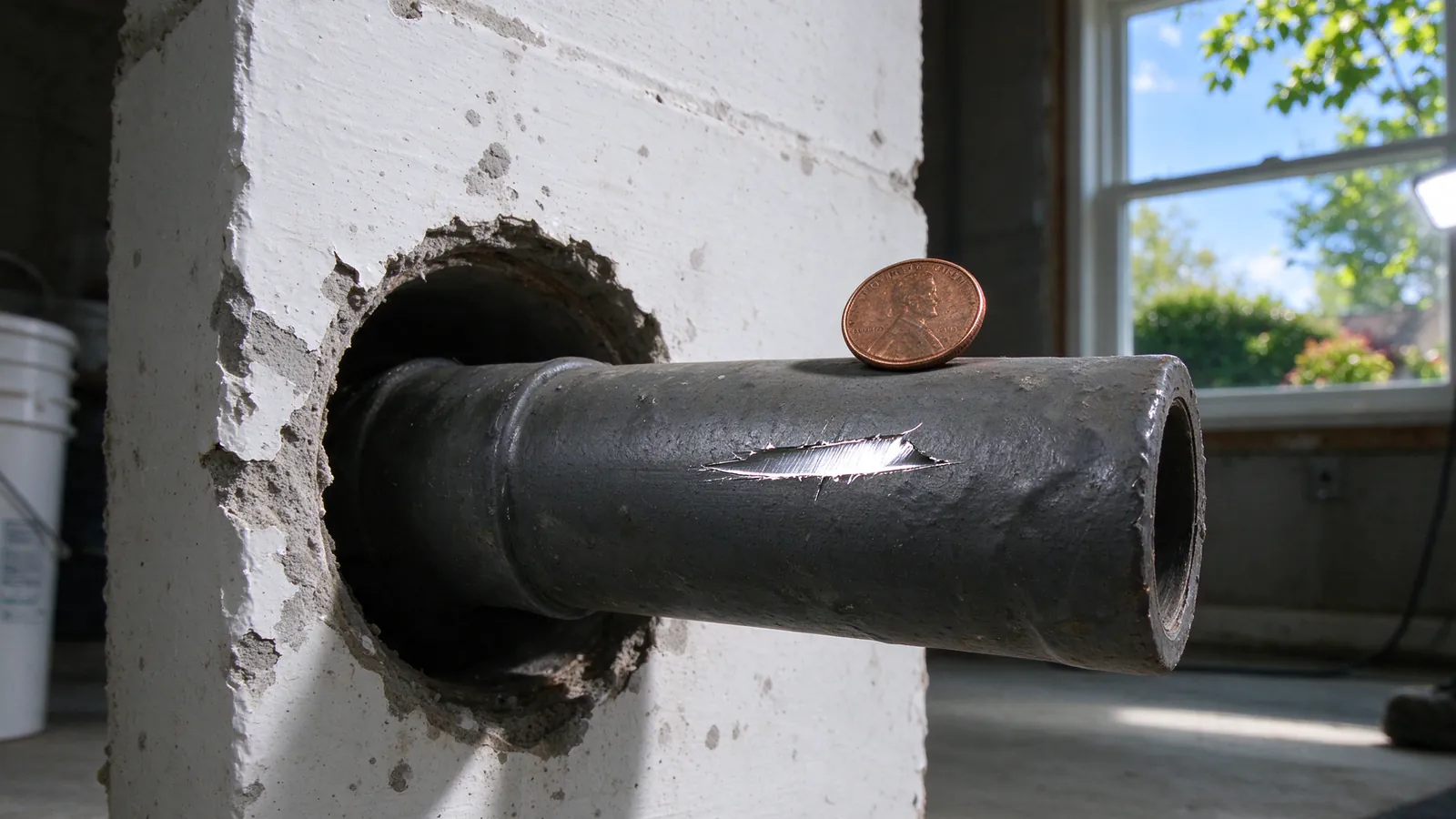
Find where the water line enters the house, usually through the basement wall near the inside meter. A lead pipe is dull gray, soft, and a magnet will not stick to it; a gentle scratch with a coin shows shiny silver. Galvanized steel is gray, threaded at its joints, and magnetic.
Slate Repiping Columbus offers and manages galvanized pipe replacement, repiping and lead service line replacement across Columbus and nearby Franklin County communities, carried out by licensed and insured plumbing contractors. This guide covers every common water pipe material in Columbus houses, how to check it without risk, and what it means.
Before you start: keep it safe
The checks here are the same ones the US EPA describes in its Protect Your Tap guide. They need nothing more than a flashlight, a fridge magnet and a coin or key. A few rules keep them safe:
- Scratch lightly. A gentle scrape is enough. Never use a knife, file or sandpaper, and never cut, heat or bend a pipe.
- Leave corroded or leaking pipe alone. Old steel or lead that is wet, flaking or already weeping can be thin enough to start leaking if it is scraped.
- Stay away from electrical connections. Water pipe often carries a ground wire clamped to it. Do not touch, loosen or remove clamps or wires, and do not test pipe near wiring if you are standing in water.
- Do not crawl into tight spaces. If the only view of a pipe is in a low crawlspace or behind a finished wall, let a plumber look.
- Wash your hands after touching pipe that might be lead, and keep children away from it.
Where to look
In most Columbus houses the service line comes through the basement wall near the inside water meter; the City says so in its customer notices. Look at the short length of pipe between the wall and the meter, and the first few feet after it. That is the service line, and it is the pipe the City’s program cares about. Then follow the main from the meter across the basement ceiling to the water heater and the branches. A Columbus house often shows a mix: steel near the meter, copper where an earlier owner fixed a leak, and steel again further on.
Identifying each material
| Material | Color and look | Magnet | Gentle scratch | Joints and clues |
|---|---|---|---|---|
| Lead | Dull gray, sometimes painted | Does not stick | Shiny silver, soft | Often a rounded, bulb-shaped joint; may bend or sag |
| Galvanized steel | Gray to silver-gray, often rusty at joints | Sticks | Still gray, hard | Threaded joints and fittings |
| Copper | Penny brown, green patina in places | Does not stick | Bright copper | Soldered or pressed fittings |
| Polybutylene | Gray plastic; blue or black for some service lines | Does not stick | Not needed | Often stamped PB2110; crimp rings of copper or aluminum |
| CPVC | Rigid cream, tan or light yellow plastic | Does not stick | Not needed | Glued fittings; printed CPVC and ASTM D2846 |
| PEX | Flexible red, blue, white or gray tubing | Does not stick | Not needed | Printed PEX and ASTM F876; crimp, clamp or expansion fittings |
Lead
Lead service lines were used in many older Columbus neighborhoods. Columbus stopped allowing new lead or galvanized service lines in December 1963, and the City says a line installed after 1964 is likely not lead or galvanized. Lead is soft enough that a coin leaves a bright mark easily. If you find lead, the Columbus lead service line program guide explains the City’s replacement schedule and LEAP loan.
Galvanized steel
Galvanized steel was the standard supply pipe in many Columbus houses built before the 1960s. A magnet grabs it firmly. Rust at threaded joints and low flow at fixtures are typical. The guide to whether galvanized pipes are safe explains why galvanized downstream of a lead line is a lead concern too.
Copper
Copper took over from mid-century. Clean copper is easy to spot, but painted copper and painted lead can look alike from a distance, which is when the coin scratch helps. Copper itself is not a lead source, but its joints may be: lead solder was banned in home plumbing in 1986, and the City advises that homes built before 1989 may have copper joined with lead solder. Solder cannot be judged reliably by eye.
Polybutylene, CPVC and PEX
All three are plastic and none is magnetic, so the print matters. Polybutylene appears in some homes built or remodeled in the 1980s and 1990s, and the polybutylene pipe replacement page explains why it is usually replaced as a system. CPVC is rigid and glued; the CPVC guide covers how it ages. PEX is flexible and printed with its standard; the guide to whether PEX is safe explains what that print means. A blue or gray line with no readable print can be either PEX or polybutylene, and in that case a plumber can usually tell from the fittings.
Brass, fittings and lead-free rules
Brass valves and fittings show up in every kind of system. Brass is a yellowish metal and not magnetic. Older brass is a lead source of its own: according to the City of Columbus, brass could contain up to 8% lead until 2014. Fittings and valves sold for drinking water now have to meet the federal lead-free limit, and products certified to NSF/ANSI 372 carry that mark. Old faucets and valves cannot be judged by look, which is one reason a repipe that also replaces valves and stops removes more than just pipe.
Not sure what you found?
A walk-through traces the pipe from the meter and names every material in the system.
Columbus’s lead line map and records
Inside the City water system, Columbus publishes an interactive service line map that shows the material on record for each address. The City’s map shows possible lead or galvanized lines at roughly 50,000 to 60,000 homes. Its inventory covers Columbus and the suburbs Columbus serves directly, such as Upper Arlington, Grandview Heights, Whitehall and Worthington.
Some suburbs keep their own records. Bexley, Gahanna and Reynoldsburg buy Columbus water through master meters, and Westerville runs its own water system, so the Columbus map has almost no points there. Owners in those places should check with their own city.
The Franklin County Auditor’s property records list permits for each parcel, which can show past plumbing work such as an earlier service line or repipe. A notice on a Columbus water bill about the line’s material is an inventory notice, not a water test.
What each material means for the house
| What you found | What it can mean | Where to read next |
|---|---|---|
| Lead service line | Eligible for the City’s replacement program inside Columbus | Lead service line program |
| Galvanized service line or interior pipe | Possible lead in scale if lead was upstream; low flow; rust | Galvanized pipe replacement |
| Copper with old joints | Possible lead solder before 1986; pinholes in some runs | Copper pinhole leaks |
| Polybutylene | Fitting failures; usually replaced as a system | Polybutylene replacement |
| CPVC or PEX | Usually modern; check age, support and listing | CPVC guide |
When to stop and call
If the pipe is hidden, painted in a way that resists a light scratch, or the results do not match any row in the table, a plumber can identify it in minutes. The same goes for a mixed system where it is unclear what feeds what. Knowing the material is the first step; tracing the whole system is what decides the scope. The repiping assessment turns what you found into a starting point, and the rusty water guide helps if discolored water is what started the search.